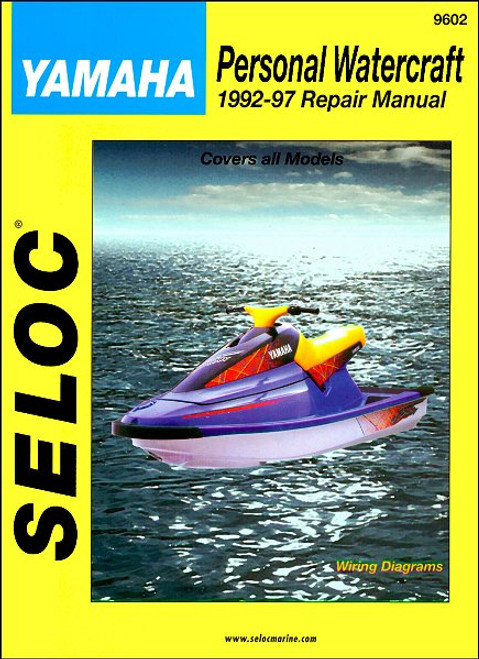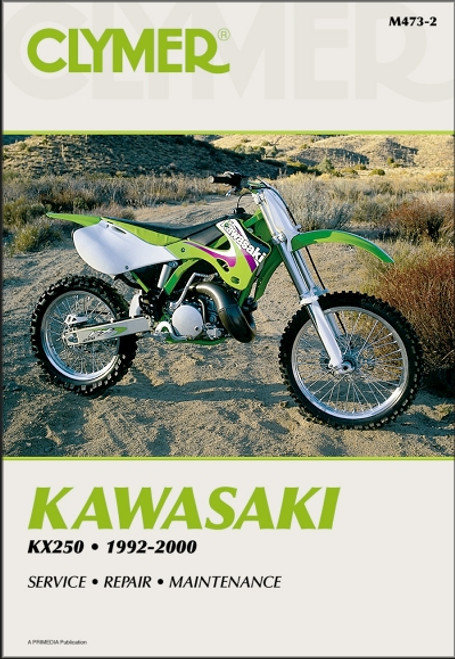


This Seloc repair and workshop manual covers 1992-1997 Kawasaki Personal Watercraft including,
Book Excerpt: 1992-1997 Kawasaki JS550, JF650, JL650, JS650, JH750, JS750, JT750, JH900, JT900, JH1100, JT1100 Repair Manual IGNITION
FUEL SYSTEM
ELECTRICAL
Subject: 1992, 1993, 1994, 1995, 1996, 1997 Kawasaki JS550, JF650, JL650, JS650, JH750, JS750, JT750, JH900, JT900, JH1100, JT1100 repair workshop manual. ISBN-10: 089330042X | ISBN-13: 9780893300425
- Kawasaki JS550
- Kawasaki JF650
- Kawasaki JL650
- Kawasaki JS650
- Kawasaki JH750
- Kawasaki JS750
- Kawasaki JT750
- Kawasaki JH900
- Kawasaki JT900
- Kawasaki JH1100
- Kawasaki JT1100
Book Excerpt: 1992-1997 Kawasaki JS550, JF650, JL650, JS650, JH750, JS750, JT750, JH900, JT900, JH1100, JT1100 Repair Manual IGNITION
7-1 INTRODUCTION AND CHAPTER COVERAGE The less a marine engine is operated, the more care it needs. Allowing a marine engine to remain idle will do more harm than if it is used regularly. To maintain the engine in top shape and always ready for efficient operation at any time, the engine should be operated every 3 to 4 weeks throughout the year. The carburetion and ignition principles of two-cycle engine operation MUST be understood in order to perform a proper tune-up on a marine engine. If you have any doubts concerning your understanding of two-cycle engine operation, it would be best to study the operation theory section the first portion of Chapter 8, before tackling any work on the ignition system. A Capacitor Discharge Ignition (CDI) is used on all engine models covered in this manual.
FUEL SYSTEM
LEAK DOWN PROCEDURE On a two-stroke engine, the crankcase has to be completely sealed to prevent pressure from escaping during primary compression. This same pressure sealing is also necessary to prevent a change in the air/fuel mixture -- resulting in a lean mixture - - being delivered to the cylinder. First, take measures to seal off the intake and exhaust manifolds. Next, obtain a pressure/ vacuum gauge and a "Mini-Vac" device. Now, plug all vacuum lines at the crankcase. Remove a spark plug. Using a spark plug adapter threaded into the spark plug opening, pressurize the crankcase through the spark plug opening with the "Mini-Vac" device to 6 psi. After six minutes, the pressure loss should not exceed one inch per minute for six minutes.
ELECTRICAL
9-1 INTRODUCTION The battery, cranking system, starter interlock, stop or "kill" switch, electric bilge pump and fan, temperature warning system, and trim motor -- if equipped -- are all considered subsystems of the electrical system. Each of these areas will be covered in this chapter beginning with the battery. The charging system is considered a subsystem of ignition and is covered in detail in Chapter 7. 9-2 BATTERIES The battery is one of the most important parts of the electrical system. Because of its job and the consequences, (failure to perform when needed), the best advice is to purchase a well-known brand, with an extended warranty period, from a reputable dealer. PERSONAL WATERCRAFT BATTERIES The battery developed for use in a personal watercraft is the same kind used for many years on motorcycles. Personal watercraft batteries are required to perform under the most rigorous conditions. Personal watercraft batteries have a much heavier exterior case than the usual automobile battery to withstand the violent pounding and shocks imposed on it as the craft moves through rough water. The battery case must also be vibration and seepage resistant. Therefore, a personal watercraft battery should always be the best the owner can afford.
Subject: 1992, 1993, 1994, 1995, 1996, 1997 Kawasaki JS550, JF650, JL650, JS650, JH750, JS750, JT750, JH900, JT900, JH1100, JT1100 repair workshop manual. ISBN-10: 089330042X | ISBN-13: 9780893300425
SEPARATE CHAPTERS INCLUDE...
- Description and operation
- Safety
- Tuning
- Maintenance
- Troubleshooting
- Fuel
- Ignition
- Engine
- Electrical
- Jet pump
- Control adjustments
- Wiring diagrams
- plus... hundreds of photos and illustrations