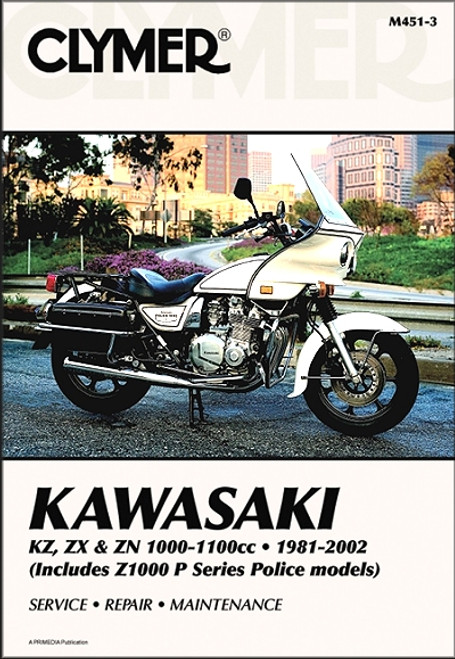


The 1973-1981 Kawasaki Z1, KZ900, KZ1000, Z1R repair and service manual by Clymer, covers the following models:
Book Excerpt: 1973-1981 Kawasaki Z1, KZ900, KZ1000, Z1R Repair Manual WHEELS AND TIRES
ELECTRICAL SYSTEM
Subject: 1973, 1974, 1975, 1976, 1977, 1978, 1979, 1980, 1981 Kawasaki Z/KZ 900/1000 service, maintenance, repair. ISBN-10: 0892878371 | ISBN-13: 9780892878376 | Clymer M359-3
- Kawasaki Z1, 1973-1974
- Kawasaki KZ900, 1975-1976
- Kawasaki KZ1000, 1977-1978
- Kawasaki KZ1000 Standard, 1979-1980
- Kawasaki KZ1000 Classic, 1980
- Kawasaki KZ1000 LTD Limited, 1977-1980
- Kawasaki Z1R, 1978-1980
- Kawasaki KZ1000C Series Police, 1978-1981
Book Excerpt: 1973-1981 Kawasaki Z1, KZ900, KZ1000, Z1R Repair Manual WHEELS AND TIRES
This chapter describes disassembly and repair of the front and rear wheels, hubs and tires. For routine maintenance, see Chapter Three. Separate procedures are given for wheel removal and disassembly for 900cc, 1000cc chain drive and shaft drive models. Make sure you use the procedure and illustrations applicable to your bike. FRONT WHEEL (900cc): REMOVAL
- Unscrew the serrated mounting nut at the bottom of the speedometer cable with pliers. Pull out the speedometer cable.
- Prop up the motorcycle so that the front wheel is several inches off the ground.
- Use a grease pencil to draw a vertical line across the mating surfaces at the bottom of each front fork tube and the axle clamp, in front, for reference as to location and position when reinstalling them.
- Unscrew the 4 axle clamp nuts. Take off the clamps, and allow the wheel to drop out of the forks.
ELECTRICAL SYSTEM
CONDENSER: CONTACT POINT MODELS The condenser normally requires no service. If the condenser has deteriorated internally, it will no longer store current temporarily. It will allow a spark to jump across the points after they have opened, causing the electromagnetic field in the ignition coil to collapse more slowly. This will lower the voltage generated in the secondary windings of the coil, and weaken the ignition sparks. IGNITION COIL An ignition coil can fail in any of 3 ways. It can develop an open circuit (broken wire) in the primary windings or the secondary windings, in which case the coil won't function at all, or it can develop a partial short circuit, arcing to bridge some of the secondary windings. If that happens, the coil will generate weak sparks at the electrodes of the spark plugs.
Subject: 1973, 1974, 1975, 1976, 1977, 1978, 1979, 1980, 1981 Kawasaki Z/KZ 900/1000 service, maintenance, repair. ISBN-10: 0892878371 | ISBN-13: 9780892878376 | Clymer M359-3
TABLE of CONTENTS:
- General Information
- Troubleshooting
- Lubrication, Maintenance and Tune-up
- Engine
- Clutch and External Gearshift Linkage
- Transmission and Internal Shift Mechanism
- Fuel and Emission Systems
- Exhaust System
- Electrical System
- Wheels, Tires and Drive Chain
- Front Suspension and Steering
- Rear Suspension
- Brakes
- Body and Frame
- Wiring Diagrams