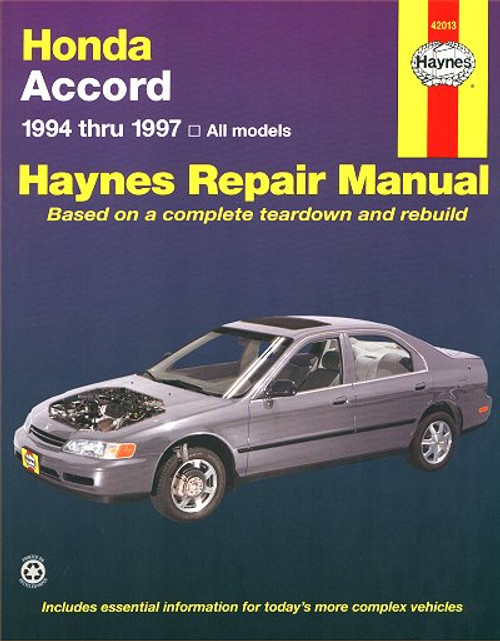


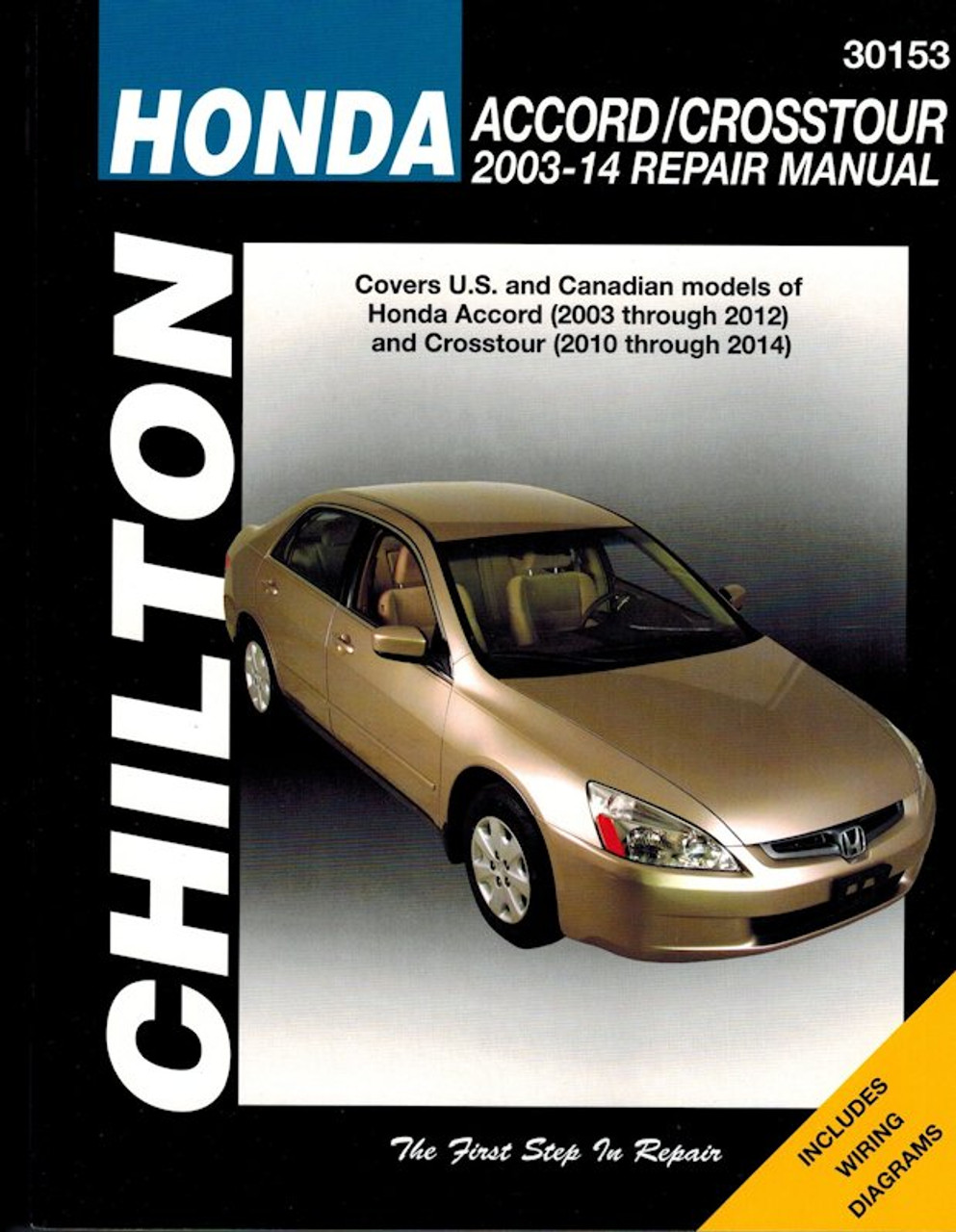

The 2003-2012 Honda Accord and 2010-2014 Honda Crosstour repair manual by Chilton, covers 2- and 4-door body styles, U.S. and Canadian models.
The specific years and models supported by this Chilton 30153 service manual are:
- 2003-2012 Honda Accord
- 2010-2014 Honda Crosstour
NOTE: This manual does not include information specific to HYBRID or ALL-WHEEL drive models.
2003-2012 Honda Accords and 2010-2014 Honda Crosstours are powered by transversely-mounted, inline 4-cylinder and V6 engines, equipped with electronic fuel injection.
The specific engines covered by this repair manual are:
- 2.4L DOHC 4- cylinder engine
- 3.0L V6 VTEC engine
- 3.5L V6 VTEC engine
Transaxles available include a 5-speed manual or a 4-speed automatic.
Honda car owners who wish to stay out of the mechanic's shop at all costs could save thousands by purchasing the Honda Accord and Crosstour Repair Manual 2003-2014 available at The Motor Bookstore. Covering most common repairs, the Chilton Honda Crosstour service repair manual will guide the way for DIY repairs on removing and inspecting the V6 engine, the operation of the suspension and steering systems, maintenance of the transmission, driveline, brakes, fuel and exhaust systems and more. This 432-page manual contains hundreds of photos and illustrations, as well as informative wiring diagrams, so that Honda Accord and Crosstour owners can undertake the repairs themselves--a less costly option than paying a mechanic. Shipping is free when you order from The Motor Bookstore.
Book Excerpt: 2003-2014 Honda Accord/Crosstour Repair Manual V6 ENGINES
CAMSHAFTS | REMOVAL, INSPECTION AND INSTALLATION REMOVAL (Refer to illustrations 12.4, 12.5 and 12.6)
- Remove the valve covers (see Section 4) and the timing belt and sprockets (see Section 8).
- Remove the ignition coils (see Chapter 5).
- Remove the rocker arms/shafts as an assembly (see Section 11).
NOTE: Refer to the inspection procedures below and check camshaft endplay before removing the camshafts.- Remove the EGR valve to access the rear plate for the camshaft (see illustration).
- Remove the camshaft retainer plate (see illustration).
- Carefully slide the camshaft out of the cylinder head, being careful not to nick the lobes or journals as you withdraw it (see illustration).
INSPECTION (Refer to illustrations 12.8, 12.9a and 12.9b)- Keeping careful track of the location of the components (see illustration 11.5), remove the rocker arms and springs from the rocker shafts and bolt the bare rocker shafts to the cylinder head, tightening them to the torque listed in this Chapter's Specifications.
- Mount a dial indicator so that it contacts the nose of the camshaft (see illustration). Pry the camshaft forwards and back with a screwdriver, with the tip taped to prevent damage to the camshaft. Record the movement of the dial indicator and compare it to this Chapter's Specifications. If the endplay is excessive, the camshaft must be replaced.
- After the endplay check, remove the rocker shafts and withdraw the camshaft. Measure the journal diameters and lobe heights on each camshaft (see this Chapter's Specifications). Check also for visual signs of wear, scoring, pitting or overheating.
NOTE: The arrangement of lobes is different between the front and rear camshafts (see illustrations).
SUSPENSION AND STEERING SYSTEMS
POWER STEERING PUMP | REMOVAL AND INSTALLATION
(Refer to illustration 20.3) NOTE: Use shop towels to protect engine components from spilled fluid during this procedure. Clean any spilled fluid immediately.
- On V6 models, remove the engine mount bracket on the right side of the engine (see Chapter 2B).
- Remove the drivebelt (see Chapter 1).
- Place a clamp on the power steering feed hose to minimize fluid loss when the hose is disconnected, and then disconnect the fluid hoses at the pump (see illustration). Note the difference between the pressure and the return (feed) hoses; the return hose is held to the pump with a spring type clamp, and the pressure line has two bolts holding it to the pump body. Cap or plug both hoses to prevent leakage or contamination. Install a new O-ring on the end of the pressure line.
- Remove the pump mounting bolts and then remove the pump from the engine.
- Installation is the reverse of removal. Be sure to bleed the power steering system (see Section 21).
Subject: 2003, 2004, 2005, 2006, 2007, 2008, 2009, 2010, 2011, 2012 Honda Accord & 2010, 2011, 2012, 2013, 2014 Honda Crosstour service, maintenance, and repair procedures. ISBN-10: 1620922088 | ISBN-13: 9781620922088 | Chilton 30153
- Tune-up and routine maintenance
- General engine overhaul procedures
- Cooling, heating and air-conditioning systems
- Fuel and exhaust systems
- Engine electrical systems
- Emissions and engine control systems
- Transmission
- Driveline
- Brakes
- Suspension and steering systems
- Body
- Chassis electrical system
- Wiring diagrams