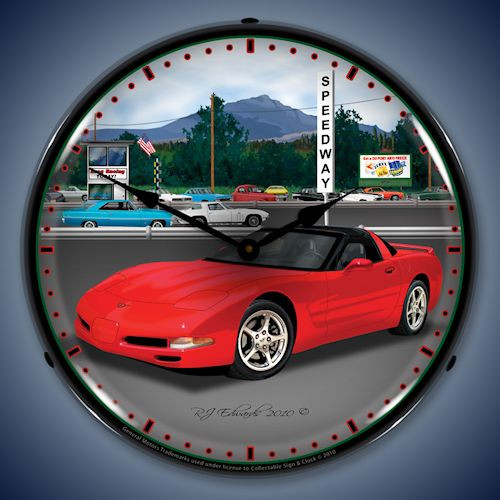


In High-Performance C5 Corvette Builder's Guide, author and Corvette expert Walt Thurn, provides a performance guide for the almost quarter of a million 'Vettes sold between 1997 and 2004. Available with LS1 and LS6 engines, the C5 Corvette took a giant leap ahead of the C4, and with the introduction of the C6, these Corvettes are far more affordable, which is great news for enthusiasts. The book starts with a brief development history of the C5 and the models available. Then it gives the reader valuable tips on purchasing a Corvette C5, routine maintenance and other tips to keep your C5 in top running condition. From there, High-Performance C5 Corvette Builder's Guide delves deep into the car's suspension, wheels, tires, braking system, driveline and engine, spanning from basic bolt-on performance add-ons to more involved, serious modifications all accompanied by easy-to-understand, helpful tables, graphs, photos and illustrations. Get the right info and modify your C5 Corvette for drag racing, road racing, autocross or simply transform it into a head-turner on cruise nights.
Book Excerpt: High-Performance C5 Corvette Builder's Guide SERIOUS ENGINE MODIFICATIONS
About the Author Walt Thurn has been involved with Corvettes since 1963. He has written many how-to articles on street Corvettes. Along with his racing coverage, he has written a number of how-to tech articles about C3, C4, C5 and C6 Corvettes.
Subject: Transportation: Automotive: High-Performance: C5 Chevy Corvette Builder's Guide. 1997, 1998, 1999, 2000, 2001, 2002, 2003, 2004 ISBN-10: 1613250266 | ISBN-13: 9781613250266 | CarTech SA127
Book Excerpt: High-Performance C5 Corvette Builder's Guide SERIOUS ENGINE MODIFICATIONS
In the last chapter, I reviewed some of the common bolt-on items owners can put on their C5s to improve power without disturbing the internals of their engines. Stock LS1s are rated at 345 or 350 hp (depending on year) at the crankshaft. What that means is that just the engines are bolted to a stationary dyno. During this type of test, the engine is not hooked to a transmission or differential. Putting a C5 on a rear-wheel chassis dyno is more real world. Rear-wheel dynos measure what the engine puts to the ground. They use large drum rollers turned by the rear wheels, and a computer measures RWHP and torque. For example, a stock LS1 rated at 345 hp usually produces between 292 to 297 rwhp. An LS6 rated at 405 hp at the crank produces 336 to 345 rwhp. Adding a good air-filter system, revised throttle body, and cat-back exhaust bumps a stock LS1 up to around 330 rwph. An LS6 with the same modifications usually produces around 355 go 365 rwhp. If you are searching for more horsepower, you must decide what to do to your car's engine next. Each choice costs you money and time away from your car. In my view, the road to more horsepower in your Corvette leads down three different roads. I am going to attempt to discuss each of these three options to allow you to make an informed choice. The first is internal engine modifications, second id supercharging, and third is turbocharging. Selecting one of these choices should be made after carefully researching your driving requirements. Drag racing, road racing, Autocrossing, street driving, and weekend track events all require different kinds of engine performance and reliability. Each of these choices has benefits and drawbacks.
About the Author Walt Thurn has been involved with Corvettes since 1963. He has written many how-to articles on street Corvettes. Along with his racing coverage, he has written a number of how-to tech articles about C3, C4, C5 and C6 Corvettes.
Subject: Transportation: Automotive: High-Performance: C5 Chevy Corvette Builder's Guide. 1997, 1998, 1999, 2000, 2001, 2002, 2003, 2004 ISBN-10: 1613250266 | ISBN-13: 9781613250266 | CarTech SA127
TABLE of CONTENTS:
- Introduction to the C5
- Buying a C5 That is Right for You
- Suspension Upgrades
- Wheels and Tires
- Brakes
- Driveline
- Basic Engine Bolt-ons
- Serious Engine Modifications
- Drag Racing
- Autocrossing
- Road Racing